You here sitted behind your drums. The drumset is composed of
various
elements gathered in a single instrument. First play the snare drum.
Listen to the sound of this one. Do the same way with the bass drum and
the tom-toms. You have just tested the drums. Now play the cymbals :
the ride, the crash and the high-hat. Now play all these sounds in the
same time.
To make you play your first rhythms I chose to start with the
pulsation, for more explanations see the strokes page and read the
chapter on the pulsation. When we can correctly play a pulse we can
work around this one. I usually present it this way : after let play
the pupil, I play some rhythms and I ask him what is the difference
between what it played and what I have just played. They give me a lot
of different answers, some really funny. But I give them the key : it's
the pulse. This one must be the first natural rhythm as well as the
reference to all that will follow.
So here is the discussion thread : the pulse is the simplest rhythm to
play, and once that this one is well understood we will be able to
change it to obtain more complex rhythms.
If we want to write this pulse we'll write it using quater notes, and
for each pulse we count 1
TAB quater notes : |1...1...1...1...|etc
Now one pulse on two, count 1-2, play only on 1, so are half notes :
TAB half notes : |1...2...1...2...|etc
Carry on and count to 4, play only on 1, so are whole notes :
TAB whole notes : |1...2...3...4...|etc
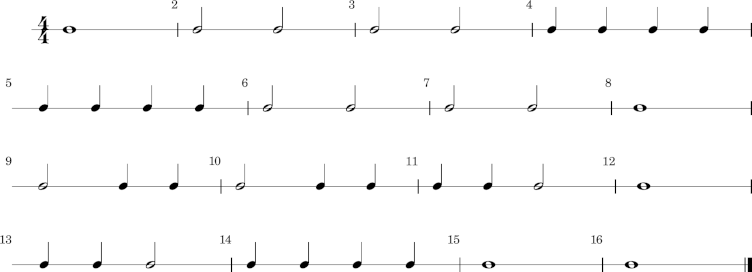
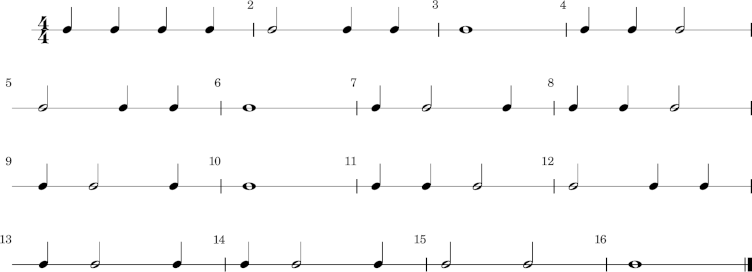
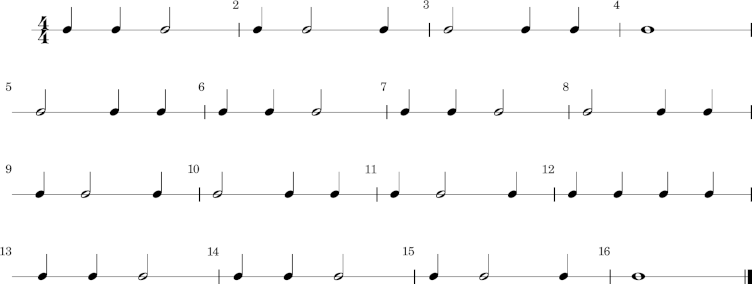
Notice that the quater notes, the half notes and the whole notes are written on single line no matter of the name of the note (ex. C,D,E,F,G,A and B) we only use what indicates the duration, what gives the value of the note. With the following exercises you play a mixture of preceding notes ; the aim is to ba able to recognize the value of each note and to count it, without losing the pulse:
TAB exercice
1 : play and count 1 for the x
|x...2...3...4...|x...2...x...2...|x...2...x...2...|x...x...x...x...|
|x...x...x...x...|x...2...x...2...|x...2...x...2...|x...2...3...4...|
|x...2...x...x...|x...2...x...x...|x...x...x...2...|x...2...3...4...|
|x...x...x...2...|x...x...x...x...|x...2...3...4...|x...2...3...4...|
TAB exercice 2 : play and count 1 for the x
|x...x...x...x...|x...2...x...x...|x...2...3...4...|x...x...x...2...|
|x...2...x...x...|x...2...3...4...|x...x...2...x...|x...x...x...2...|
|x...x...2...x...|x...2...3...4...|x...x...x...2...|x...2...x...x...|
|x...x...2...x...|x...x...2...x...|x...2...x...2...|x...2...3...4...|
TAB exercice 3 : play and count 1 for the x
|x...x...x...2...|x...x...2...x...|x...2...x...x...|x...2...3...4...|
|x...2...x...x...|x...x...x...2...|x...x...x...2...|x...2...x...x...|
|x...x...2...x...|x...2...x...x...|x...x...2...x...|x...x...x...x...|
|x...x...x...2...|x...x...x...2...|x...x...2...x...|x...2...3...4...|
Here it's the end of your first lesson. Perhaps it brings more questions than it gives answers. It is quite normal, but I do not want to feed the first lesson with too much technical explanations. So take this lesson as it comes and you will wait for the next on where you will find your answers.